August 17, 2014


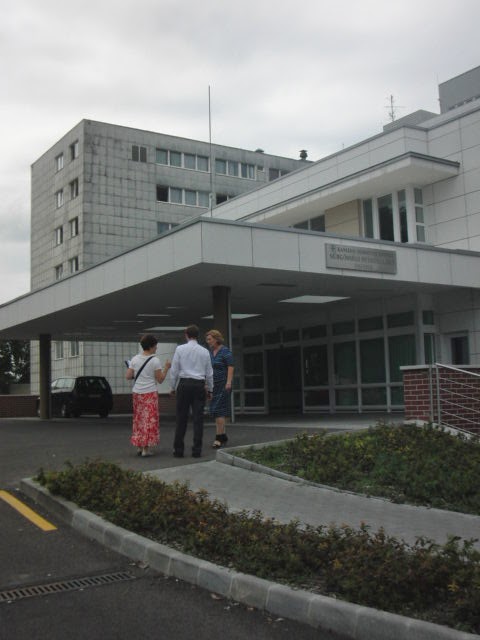
Streat (pronounced street) - a fun little sandwich deli in Pécs where we had lunch with all the missionaries after our zone training.  Meals were served on writing boards instead of plates.


Another fairly cool week.  In fact, there were two days that actually bordered on cold.  Could summer be on its way out?  Last summer temperatures got to 114, but we've only had a couple of days over 90 this year.  No complaints here, but if summer's ending, looking forward to a nice, looong Autumn.  

This was a fairly low-key, normal week.  We went with our branch president to a small village to visit a sister.  We also went with the elders to visit another sister who is having health issues.   Only one young man was at Young Single Adults this week; two girls were gone, one was working, one was grounded, and her friend was babysitting.  The young man is just getting re-activated.  He went last week to the youth conference in Germany and had a great time, learned much and felt the Spirit and was so amazed to see and interact with so many LDS youth.  He is very concerned at this point and wants to keep that wonderful spirit with him.  He’s actually a bit young for YSA, but since he’s the only youth in the branch, he’s included.  The two girls who were out of town this week were at the YSA Conference in Poland.  Apparently they had a transportation issue getting home last night and didn’t get home until 6:00 a.m. this morning.  We’re anxious to hear about their week.  They are both recent converts this year, and this will be so good for them.  

Thursday we rode the bus with our elders to Pécs (1 hour south) for zone training.  
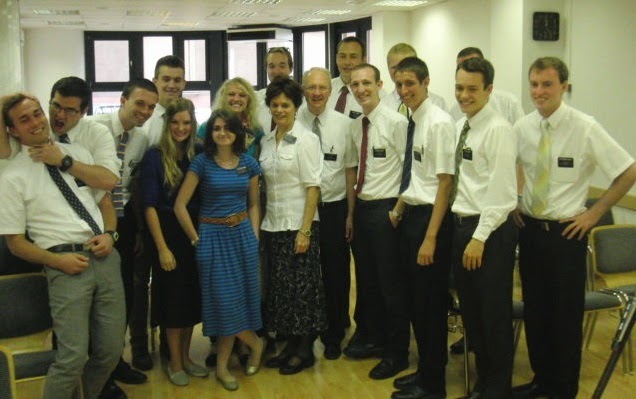

With these missionaries we were instructed in ways to become better teachers and did some role playing together.
 

We then all walked through the town’s pedestrian street to have lunch together at Streat (pictured above) before returning on the bus.  

We didn't have time to visit anything in the city, but took some pictures of interesting buildings on our walk through town.


The Pécs Synagogue was patterned after the Budapest Synagogue.  At one time there were 4,000 Jewish people in Pécs, but no longer, and the synagogue is mostly a museum.


Regular theater performances have been in Pécs since 1786. Pécs was one of the most significant provincial centers of Hungarian theatrical culture.  Comedians performed in dance halls, town houses, inns and cafes.  This Magyar Nemzeti Szinhaz (Hungarian National Theater) opened in October 1895.  After some remodeling 100 years later, it now has a revolving stage, four-part sinking orchestra pit, new light, sound and video system and is air conditioned (and that's a novelty).  Would be fun to attend a play there, but don't suppose they do them in English -- even though Pécs is a university town and there are many English speaking students.


This was once a monastery, then the Church of the Good Samaritans, a hospital, and at present it is a surgical clinic of the University of Pécs Medical School.


Oh, we walked through the Arpad Mall and stopped to use the restrooms.  These sinks were fascinating -- 6 of them along the wall. (We have mentioned before, things are really new or really old.)

Friday we had three new projects approved, so will be getting busy with those. 


The only reading (for enjoyment) time we take is reading to go to sleep, but we both just finished a fascinating book, Safe Journey, An African Adventure by Glenn L. Pace about his African years and experiences.  May we share just one of the fascinating stories (in shortened form):

Remember when Church members were asked to fast for the Ethiopian drought and famine in 1985?  There had been no rain in Ethiopia for over two years, and hundreds of thousands died. At that time Elder Pace was employed by the Church as the Managing Director of the Welfare Services Department.  The response to that fast exceeded anything the Brethren had anticipated -- $6 million.   At that time there was no infrastructure or license in the Church to deliver aid to various parts of the world so they were dependent on using other organizations.  Brother Pace was sent immediately to Washington, D. C and New York City to learn all he could about agencies involved in administering assistance.  After extensive research he reported to the Brethren and recommended that the Church donate $1.4 million to Catholic Relief Services.  He said he observed several raised eyebrows and was asked to elaborate a little bit.  He explained that his assignment was to make sure the aid reached the people in need, and it was his opinion that the Catholic Church had the infrastructure to accomplish that.  Their  response, “We have no further questions.” 

Next he and Elder M. Russell Ballard went to Ethopia to be check on the actual distribution.  After traveling about 24 hours, Brother Pace was ready to get to their hotel and collapse.  However, before leaving Utah Elder Ballard had found out that there was one member of the Church in Ethiopa.  He was a man from Seattle temporarily assigned there while doing consulting work for Ethopian Airlines. Elder Ballard wanted to find him – right then.   They began asking around at the airport and within minutes someone brought him to them.  The man had been in Ethiopa several months (without family) and was very lonely.  Elder Ballard told him they would be holding sacrament meeting the following Sunday and they would love to come to his home for the meeting.  Tears welled up in his eyes and he began to sob, “I have not partaken of the sacrament in months.”  

So, on that clear, bright Sunday morning they met, they sang, they partook of the sacrament, they bore testimony to each other, and then Elder Ballard offered a closing prayer expressing gratitude to the members of the Church who had contributed so generously and who had been praying for the people of Ethiopa. “Then, with as much power and boldness of authority. . . .he called upon the power of the holy Melchizedek Priesthood and commanded the elements to gather together to bring rain upon the land. . . .”

That afternoon while they were in their hotel, they heard a very loud clap of thunder, which was the beginning of a torrential downpour.  From their window they watched children and adults alike begin to frolic and splash on each other and fill buckets and barrels.  It was a celebration.  Of course, they knelt to say a prayer of thanksgiving. For the next two weeks, everywhere they traveled, it rained.  

That was a fascinating story (at the beginning of a fascinating book) and this experience was the beginning of what became the Humanitarian Department of the Church and LDS Charities.  We continue to be amazed at the mammoth humanitarian efforts around the world and the vision and care of the Church and the blessing that this is to Heavenly Father’s children.  We are so grateful to have a very small part in this work.  We are also grateful to you who make this work possible from your donations to the Humanitarian Fund.  We explain to those we visit that members all over the world are invited to contribute and their small amounts add up to these sacred funds which make help around the world possible.  We know that this is the Lord’s Church and we are doing His work – because all this simply would not keep going if it wasn’t. 

August 10, 2014


Stake Deacon Beehive Service activity and the finished blankets.
We had quite a bit of rain this week again.  We are always grateful for it because it cools the days down.  But we learned this week that all the rain this year has been a problem for the farmers.  The spring was very rainy; so they waited to plant and then it was late.  We didn’t get the whole story, but there’s something about the cost of drying seeds.  This week is predicted to be a hot one!  It’s almost the middle of August; I guess we should expect as much.


Monday we drove to the small town of Felcsut, about 40 minutes west of Budapest, to a stake Deacon Beehive activity where we had been asked to provide a service project for them.   We had 20 fleece blankets for the youth to help cut and tie that evening.   They did a great job.  The boys chose to cut and the girls tied.  We have 4 to finish up.  They also wrote notes to include with the blankets which will be given to children at a county home for the disabled here in Kaposvár.  


The next day in Budapest we ‘closed’ two projects – both of which have taken months to get the equipment delivered.   In the neonatal department of a hospital, Dr. Csathy, a neonatologist, had asked for two infusion pumps.  We have visited him several times and have grown to really admire and respect him.   He is very caring and devoted to these newborn babies, but he is also in charge of finding the funds needed to run this department.  We think we mentioned before that we were hoping that he could find at least half the funds so we could help replace a 28-year-old sterilizer, which he prays for every time he runs it.  However, in the meantime, their infusion pumps broke -- a critical need.  He is currently waiting to hear back from a grant request he submitted to a bank about money for the sterilizer.  We pray that will be successful.  

In Hungary, doctors are very well trained, then hired by the government, but paid very little.  The majority of doctors leave the country and practice in other countries.   We have learned from several sources that medical school here is very good training, very inexpensive and taught in English.  So, students come from all over the world to be trained.  However, if they do their residency in Hungary, it must be done in Hungarian.  That means many of these students then leave to do their residencies in other countries; and do not return to practice in Hungary.   We know of an LDS medical student from the U.S. who is married to a Hungarian; he is planning to practice in Germany.  This week we met a medical student from Iraq, going to school in Hungary; he plans to return to his home to practice.


Our other ‘closing’ was for sweet Sister Anna, one of three sisters who have operated a home for the blind and multiple-disabled children for 35 years.   They currently have 30 children who live there and 30 more who come each day.  


You will see that there are bars on all the hallways, so that the children can feel their way to get around the buildings. 


Because some of the children have disabilities that require them to be fed intravenously, they need to be periodically weighed to be sure their weight is maintained or increasing.   And the children become fairly heavy for the sisters to hold and weigh (weigh themselves, then weigh holding the child); the humanitarian funds provided a weighing chair – the child can sit in the chair to be weighed.  


Also provided was a walker for those who cannot stand or walk.  For those who have spent their life in bed, they can be strapped in at the feet, legs, back and ‘stand’ for a time and perhaps play a game or do something on the tray.  Sister Anna told us it is a whole different sensation to look at the world from a standing angle when you have spent your life in a bed.  


 This little boy kept saying “hold my hand, hold my hand.”   He just needed that touch.


On our way through the town of Felcsut we noticed a large stadium just off the road.  It looked totally out of character for this small village.   When we finished our project, we stopped to look at it.  Wow!   This is a stadium that might rival the new one in Dallas!!!!   

This is NOT a cement and steel structure.  This is an architectural design of wonder.   Check out the beautiful wood arches and truces.  It is huge, even though it only seats 4,500 – in a town of 1,700.   
 

Why such a stadium in Felcsut? We asked around and did a little research.   It seems that the current prime minister is from Felcsut and loves football (soccer).  This is at the Puskas Akedemia -- Puskas being the all-time Hungarian soccer star-- and is the place where the professional youth soccer players are trained.  Many soccer fields are adjacent to the stadium.  We learned that it costs 3.8 billion HUF, which equals $16,269,928.00 dollars – and that’s probably only because Hungarian wages are rock bottom!  Supposedly it was not built with government dollars, but the companies who donated have received 'favors' from the government.  Who ever heard of such a thing?  

The rest of the week has been the usual – research on new projects, district meeting, and Young Single Adults on Friday.   We were gone this week and missed both Family Home Evening and Hungarian class, and didn’t do any visiting of branch families this week.  We had invited a couple (our interpreter) from the branch over for dinner this evening.  We waited an hour, finally ate and when we reached them, he had forgotten to tell his wife.

In thinking about our less active members, Amulek come to mind.  Of course, the fact that an angel appeared to Amulek to tell him that he would receive/feed a prophet is quite a miracle and a good beginning to reactivation. (However, it didn't ever seem to help Laman and Lemuel.)   But Alma spent time with Amulek teaching and strengthening his testimony.  And then they went together as companions -- the prophet and a reactivated member -- to teach the people.  And what a great companion and teacher Amulek was.  He astonished  the people, was a powerful second witness for Alma, 'silenced' and then helped convert Zeezrom.  What a strength!   We are praying for an Amulek from our little Kaposvár Branch.  Please pray with us. 

August 3, 2014


Typical slice of pizza -- not always with broccoli, but ALWAYS with corn!
This was a sort of stay-at-home week.  Three times this week we went with the elders to villages outside of Kaposvár to visit less active members or to find less active members – which was not very successful.  

We had a referral for a humanitarian project at a hospital in Nagykanizsa, a town about an hour and a half away from here, so we went there one day.  The lady we met with was very gracious.  She showed us around the hospital.  she invited us to lunch in their cafeteria.  The director of the pediatric wing gave us a tour.  A few years ago they received a government grant to add an emergency wing.  The doctor in charge spent time showing us that new area.  He was very proud of their updated computer, security and records systems.  In every room, he made mention that there were enough outlets and power to use any and all machines necessary.  We realized that is probably not possible in most of these very old hospitals.  The hospital would be considered plain (or dated) by American standards, but it was very clean and very well kept, and the staff seemed to be very efficient, helpful and caring.

Today at church, we had 11 visitors from Germany -- a family of four and seven young adults -- all vacationing at Lake Balaton, about an hour from here.  Kaposvár is the closest meeting for them to attend.  The German family in our branch was there today.  He only speaks German; she speaks some English and some Hungarian, but it was wonderful for them.  In fact, because we had more Germans (the visitors all spoke English), and several who bore testimony, the meeting was mostly in English and translated into Hungarian.  So we understood without having an elder sitting next to us translated out loud during the meeting.  It was a wonderful meeting.  The visiting German family was there last week also, so we had invited them for lunch today.  We have just finished a delightful time with them.  He is the bishop in a Berlin ward and their son is on a mission in the Colorado Springs Spanish speaking mission.

In between all of this Sharon prepared 20 brightly colored fleece blankets to be tied as a service project for the stake Deacon Beehive activity tomorrow evening near Budapest. Stan spent time 'closing' the projects on paper and reconciling the accounting -- time consuming for each transaction and project.  Oh, and Sharon cooked food for our weekly family home evening and Young single Adults on Friday.  

What a rainstorm we had this afternoon -- a hailstorm, in fact.  But it will cool things down again and we'll take that any time.  It's just very sticky wet.

There's not much else to write about this week, so this will be the week to show some scenes around Kaposvár. 

One of the streetlights that has the countdown for the traffic, not the pedestrians, starts at 41 seconds.  The yellow light comes after the red -- sort of a 'ready, set, go' before the green light.  And go they do.  When it gets to this point, they know they can go!


Most mornings there will be street sweepers cleaning streets and sidewalks.


 This morning the Posta man let us take his picture. 


It is customary to leave anything you don't want (food, clothes, etc.) tied to or near the trash bin.  The Romas (Gypsies) will be happy to have it.  In fact, in the spring there is a two week period that you can do spring cleaning and put clothes (or whatever) out on the sidewalk.  After the designated time, the city will pick up whatever is not taken.  This year during that time there was much rain.  The piles of clothing were pretty ruined.  If garbage bins are not locked, the Romas will go through them for anything they deem worthwhile. 

Our city, like yours, uses summer for projects, like


replacing water lines, 


replacing sidewalks,


and more sidewalks,


and more sidewalks.

Roundabouts are very common in Hungary -- very efficient.  We love them.  They are used on the highways instead of traffic lights.  Many in Kaposvár have fountains in the middle, which are lovely. 

Speaking of fountains, we've been collecting photos.  Here are a few:


This one is in the center of the town square.

On the way to visit a member sister.
 A nice aerial view of Kaposvár city centrum -- very inviting.


Looking at the street a little closer this morning on the way to church, the flowers were 
beautiful.

Just look at all the flowers. . .

This week may we express our gratitude for our Savior's Atonement.  We finished the book, The Infinite Atonement by Tad R. Callister.  It was amazing, education and humbling; and we feel like we are just beginning to understand and appreciate this amazing gift Jesus Christ gave to us:
  • The Atonement gives purpose and potency to every event in history.
  • The Atonement of Jesus Christ outweighs, surpasses, and transcends every other mortal event, every new discovery and every acquisition of knowledge, for without the Atonement all else in life is meaningless. 
  • The Atonement is the lifeblood that quickens every gospel precept.
  • Every attempt to reflect upon the Atonement, o study it, to embrace it, to express appreciation for it, however small or feeble it may be, will kindle the fires of faith and work its miracle towards a more Christlike life. It is an inescapable consequence of so doing.  We become like those things we habitually love and admire.  And thus, as we study Christ's life and live his teachings, we become more like Him.
  • Our reception of the Atonement is the key to unlock these gifts of the Spirit (or endowments of godly traits) and all their enabling powers, for it is the Atonement that purifies us and prepares us to be eligible recipients.
  • That is the whole purpose of life, the prime objective of the Atonement, to help us to return to Him and become like Him.
  • One does not speak lightly of the Atonement or casually express its appreciation.
Like Alma, [we] cannot say the smallest part of which [we] feel.  Alma 26:16.


SITE DESIGN BY DESIGNER BLOGS